Install a marketing team in the agent runtime you already use.

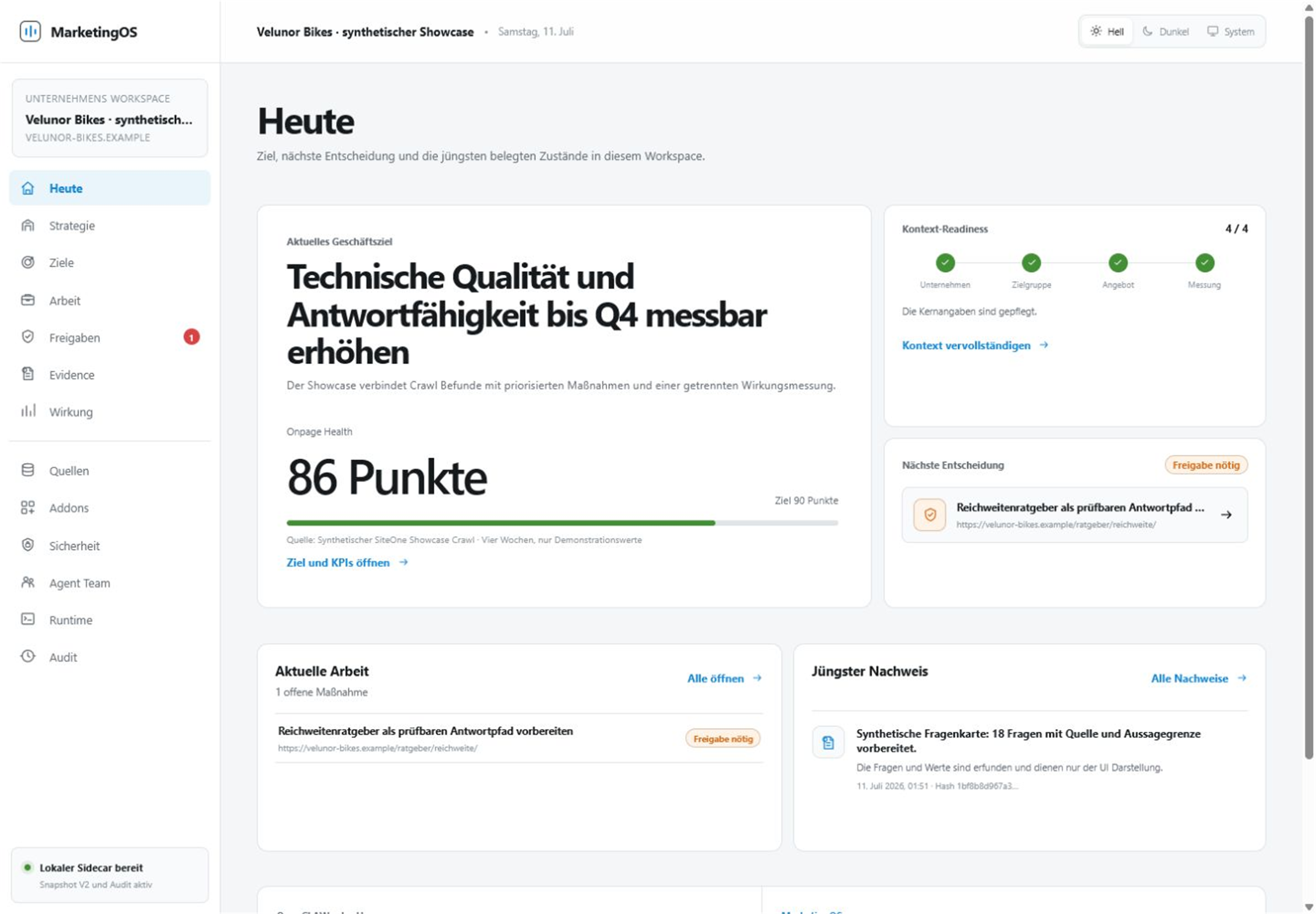
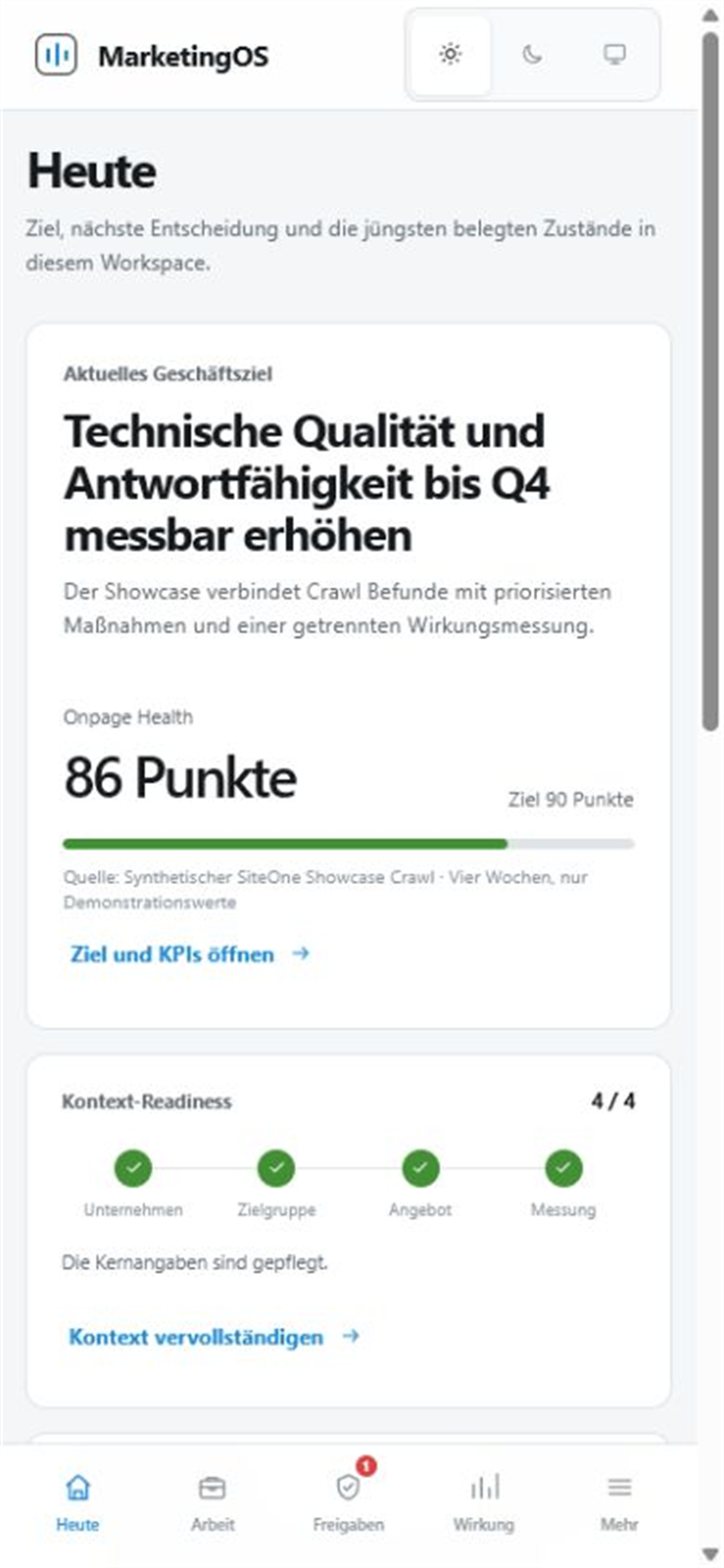
Architectural MarketingOS product installation in black metal, smoked glass and technical ivory modulesMarketingOS Today view of the synthetic Velunor Bikes showcase on desktopMarketingOS Today view of the synthetic Velunor Bikes showcase on a phone

OpenCLAW supplies models, sessions, memory, tools and channels. MarketingOS installs an orchestrator and eleven clearly separated specialist roles inside it. They work from your business context, gather evidence, prepare decisions and document each approved execution.

01

Your runtime

OpenCLAW or Hermes carries models, compute, sessions, memory, tools, secrets, schedules and channels.

02

MarketingOS

The pack brings business context, orchestrator, specialist roles, rules, evidence, approvals and receipts.

For existing OpenCLAW instances12 separated marketing agentsModel choice stays in OpenCLAWExternal writes blocked by default

The missing layer

A general agent does not know your business yet.

It can research, write and use tools. It does not automatically know which offer drives the business, which audience matters, how the brand should sound or who may approve a website change. MarketingOS makes that context durable and usable.

01

The runtime supplies the engine

OpenCLAW or Hermes provides models, compute, sessions, memory, tools, secrets, schedules and channels.

02

MarketingOS supplies the assignment

Company, brand, offer, audience, goals, KPIs, sources and rules become shared working context.

03

Specialists share the same state

The orchestrator delegates work. Specialists return findings. QA reviews them before an idea becomes an approvable action.

A working day in the system

How one question becomes a traceable marketing assignment.

  1. 01

    Context

    The brief stays in the workspace

    Domain, market, offer, audience, business goal, KPI and accountable owner are captured carefully and later versioned.
  2. 02

    Orchestrator

    The orchestrator breaks down the job

    A goal becomes bounded tasks. Each task gets a specialist role, expected evidence and a reviewable result.
  3. 03

    Specialists

    Specialists read the right sources

    Technical SEO checks the crawl and website. Measurement reviews measurability. Demand, GEO, content and other roles handle their part.
  4. 04

    Approval

    A concrete approval comes before the write

    Target system, content, business goal, risk and accountable person sit directly at the decision. Missing data remains visible.
  5. 05

    Receipt

    The receipt proves execution

    Time, target system, result, external writes and the related decision stay connected. What actually happened is what counts.
  6. 06

    Outcome

    Outcome needs a later observation

    A baseline, measurement window and later data can then show whether anything changed. Missing measurements remain explicit.

Fictional product showcase

The connection stays visible, from the brief to approval.

Velunor Bikes is an invented company. These captures come from a reproducible product state with synthetic domains, goals and metrics. They demonstrate how MarketingOS works, not customer impact.

01 / Context
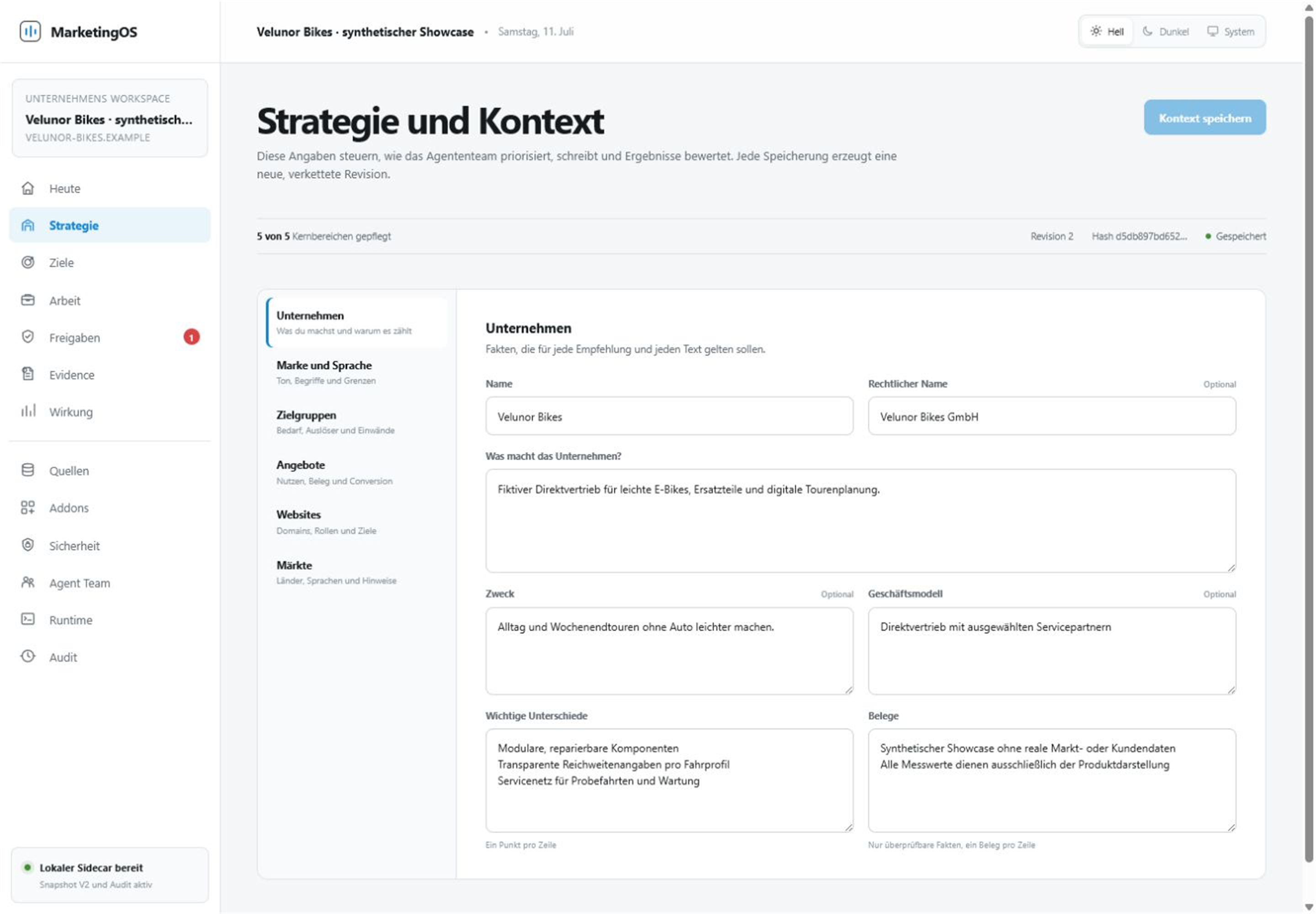
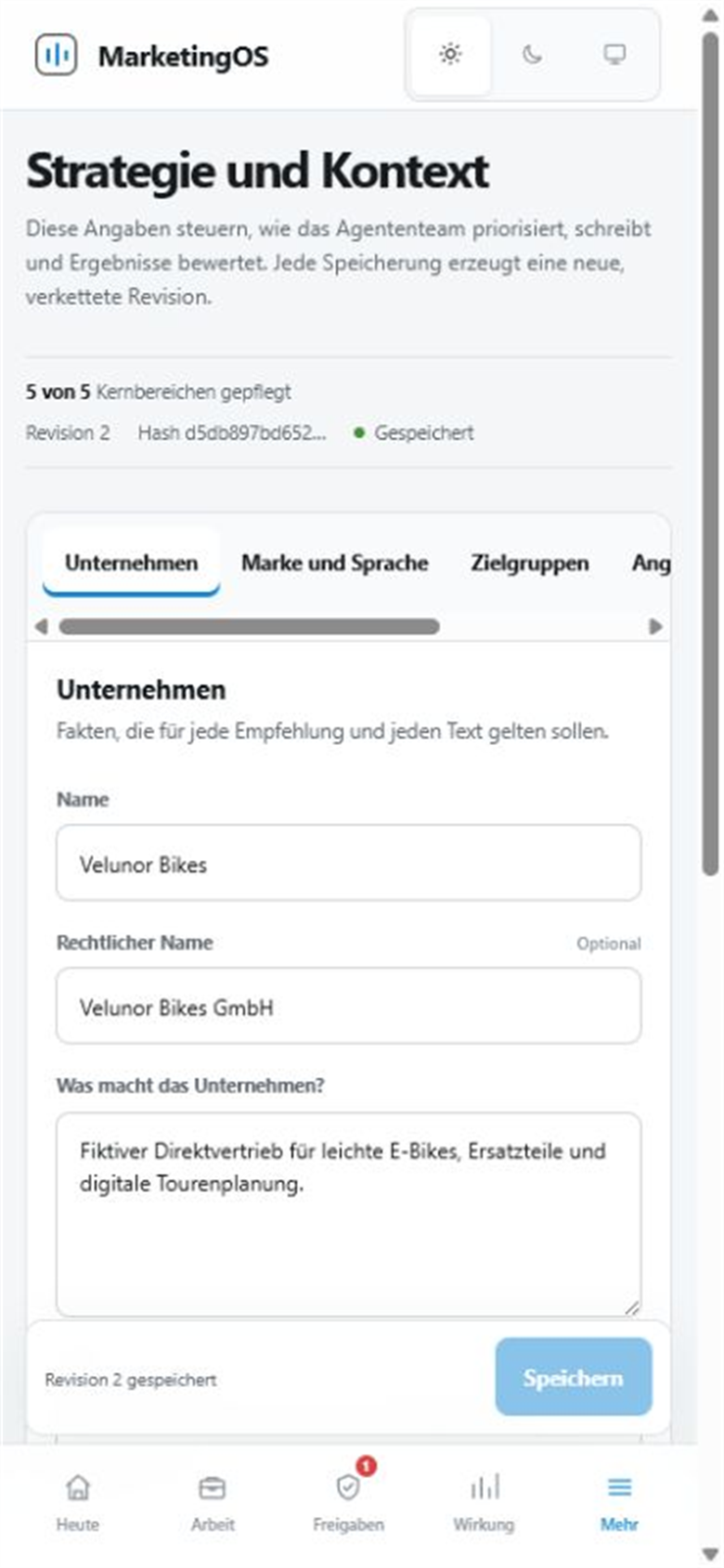
The team does not work from an empty chat.

Company, brand, audiences, offers, websites and markets share one version. Revision, hash and save state remain visible.
  • Five core areas
  • Revision 1
  • Hash and save state
MarketingOS Strategy and Context for the synthetic Velunor Bikes showcaseMarketingOS Strategy and Context for Velunor Bikes on mobile

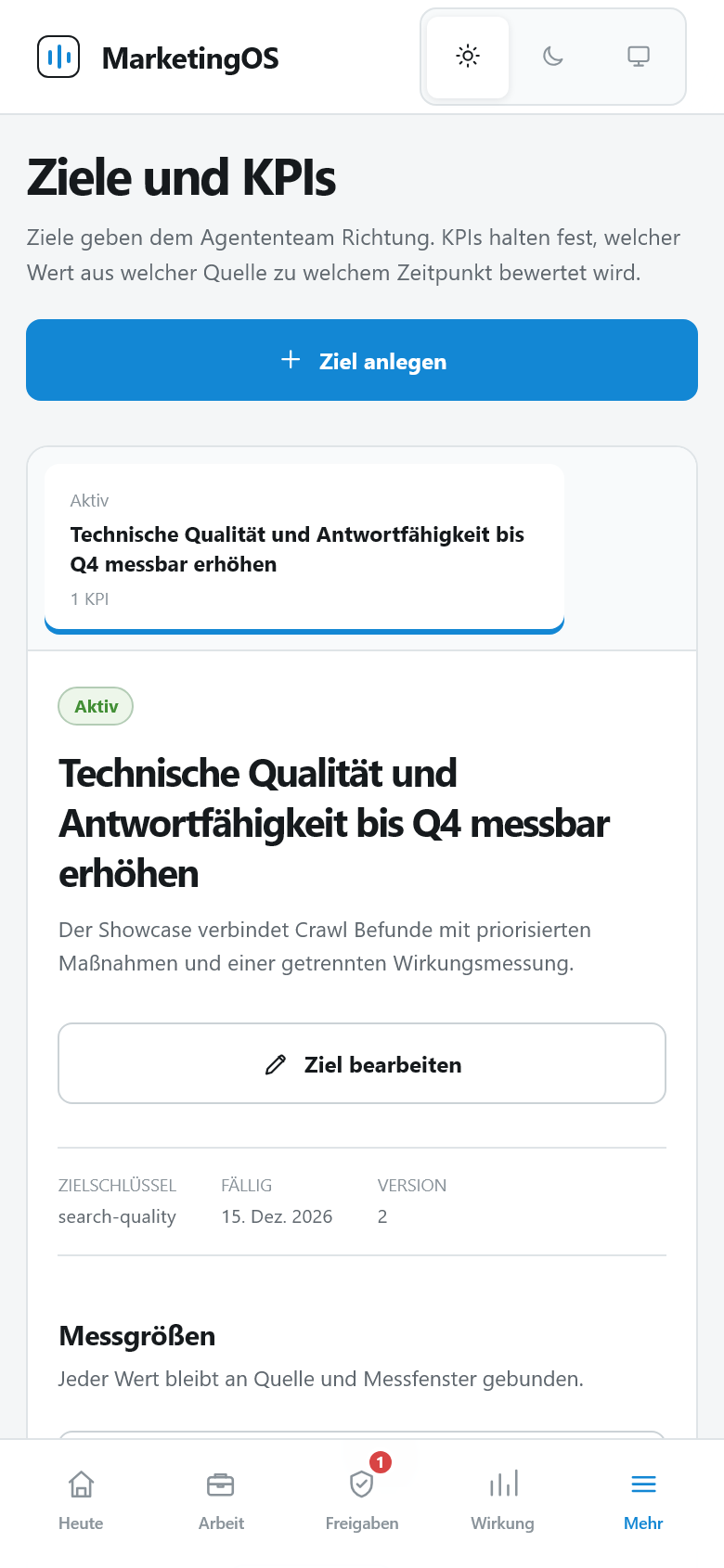
02 / Goal

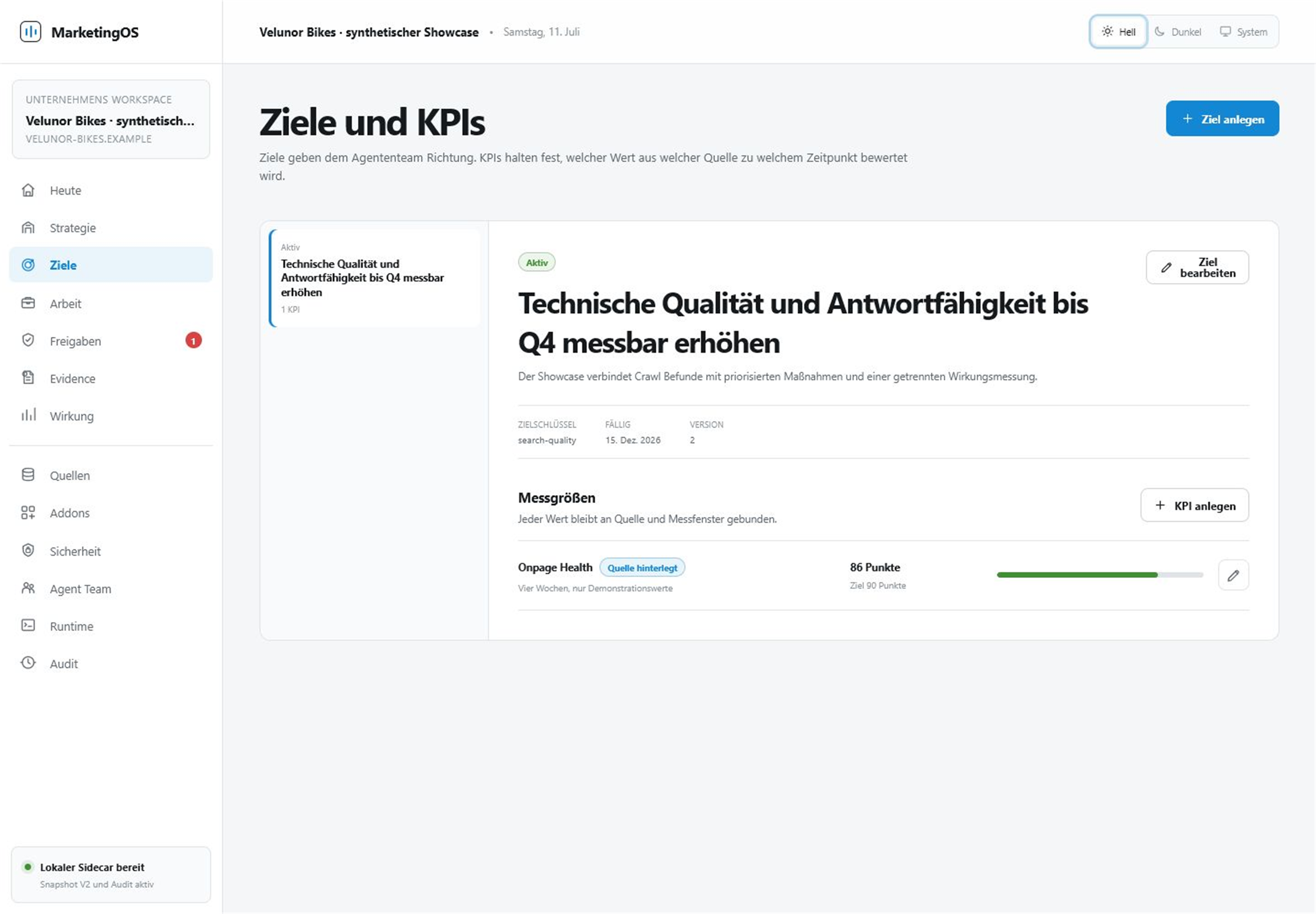
Activity starts with a business goal.

The goal carries the metrics. Source, time window, current value and target sit where the team reviews its priorities.
  • Fictional business goal
  • Synthetic source
  • Time window
  • Target
MarketingOS Goals and KPIs in the synthetic Velunor Bikes showcase

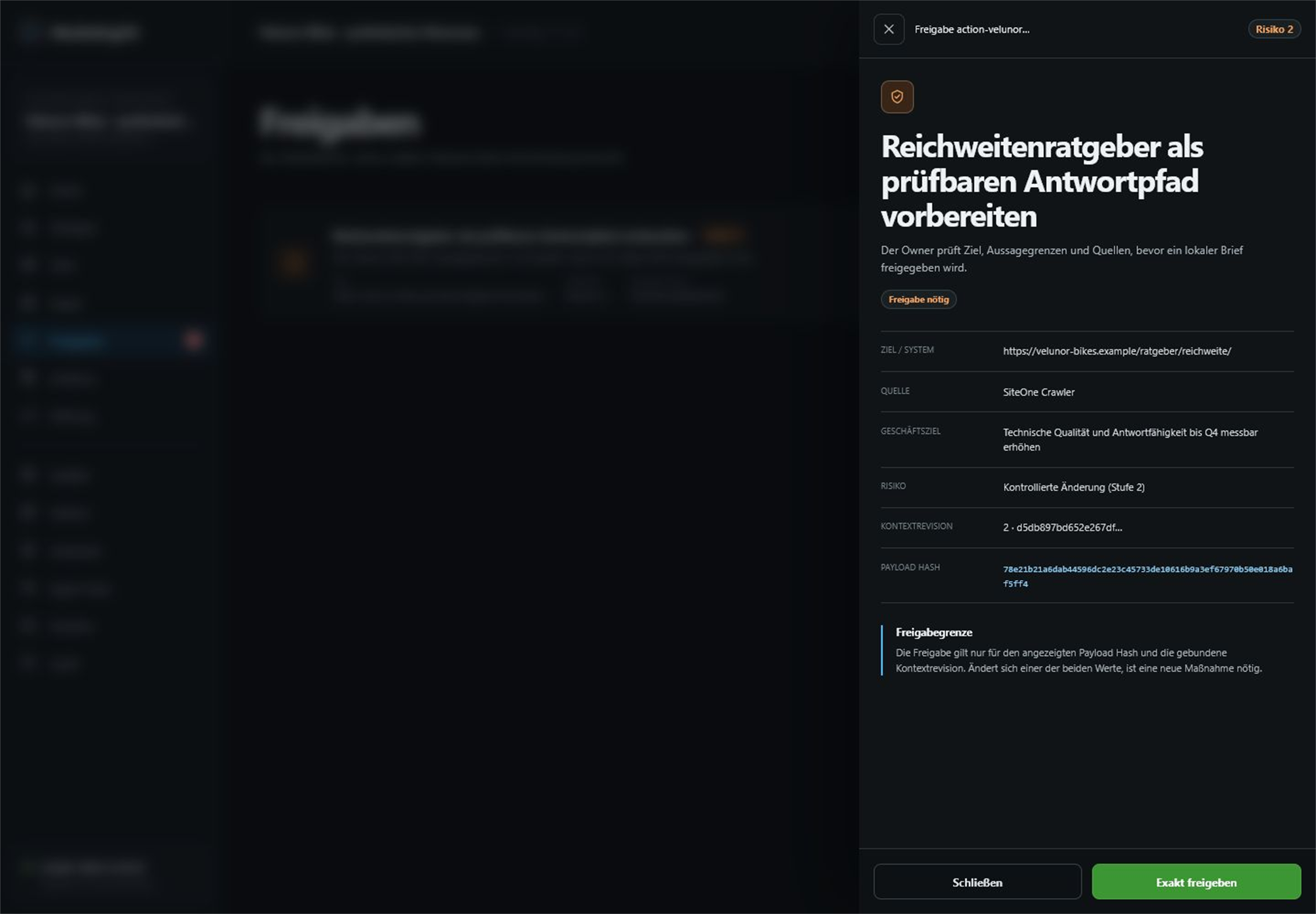
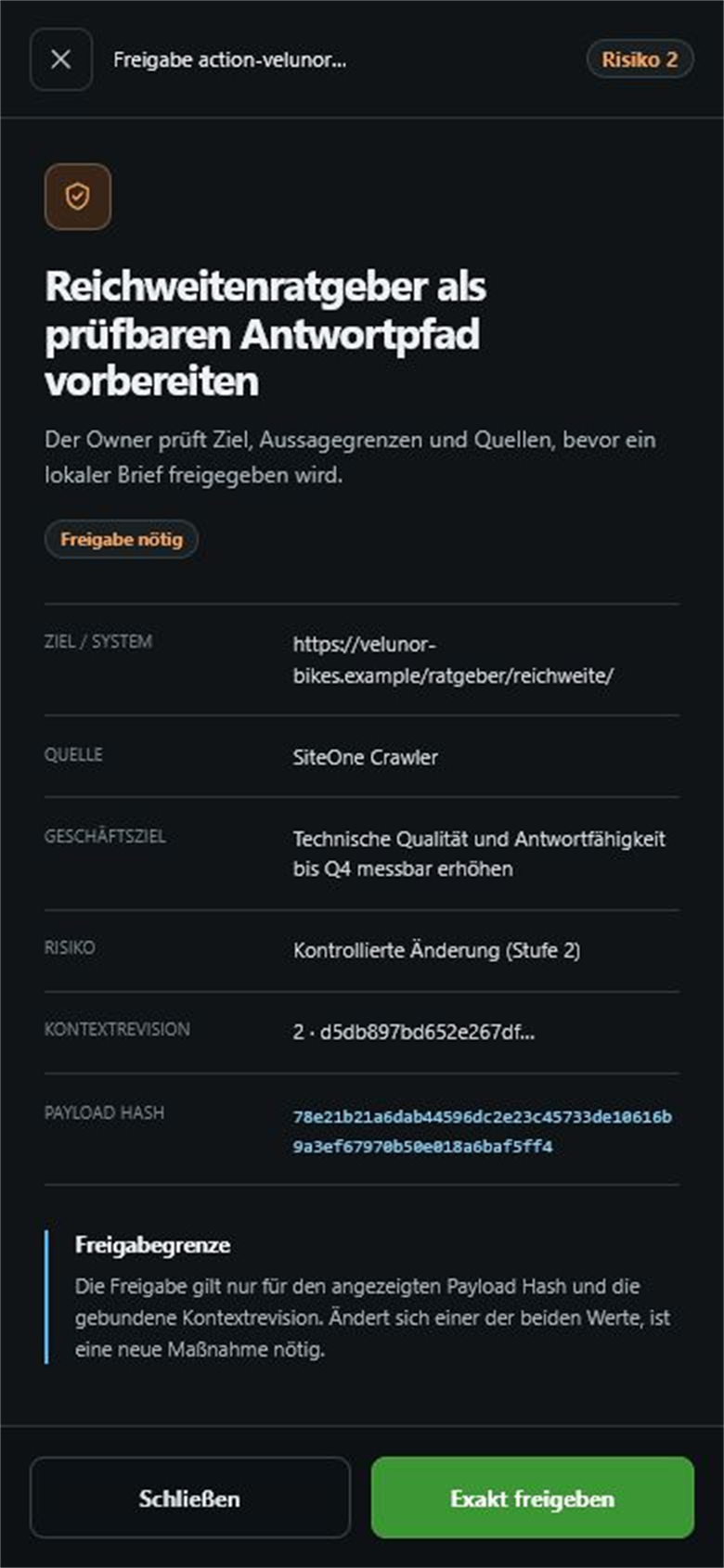
03 / Decision

Before a write, a person sees the context and exact content.

The synthetic Technical SEO assignment shows its target system, business goal, risk, context revision and payload hash at the decision. If any bound value changes, the approval no longer applies.
  • Context revision
  • Risk 2
  • Payload hash
  • One concrete approval
MarketingOS approvals with a synthetic context bound Technical SEO assignmentMobile MarketingOS approval for the synthetic Velunor Bikes assignment

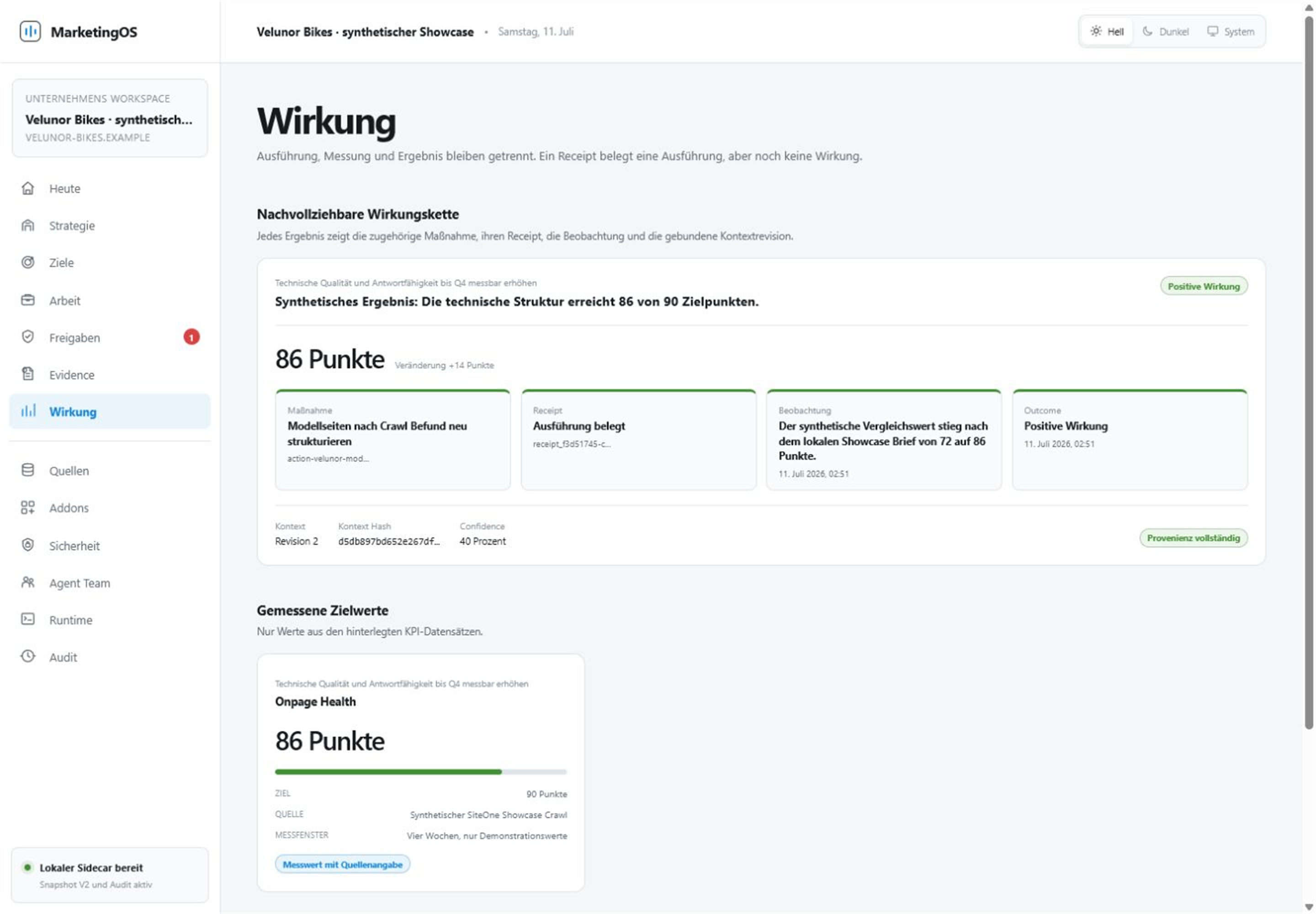
04 / Outcome

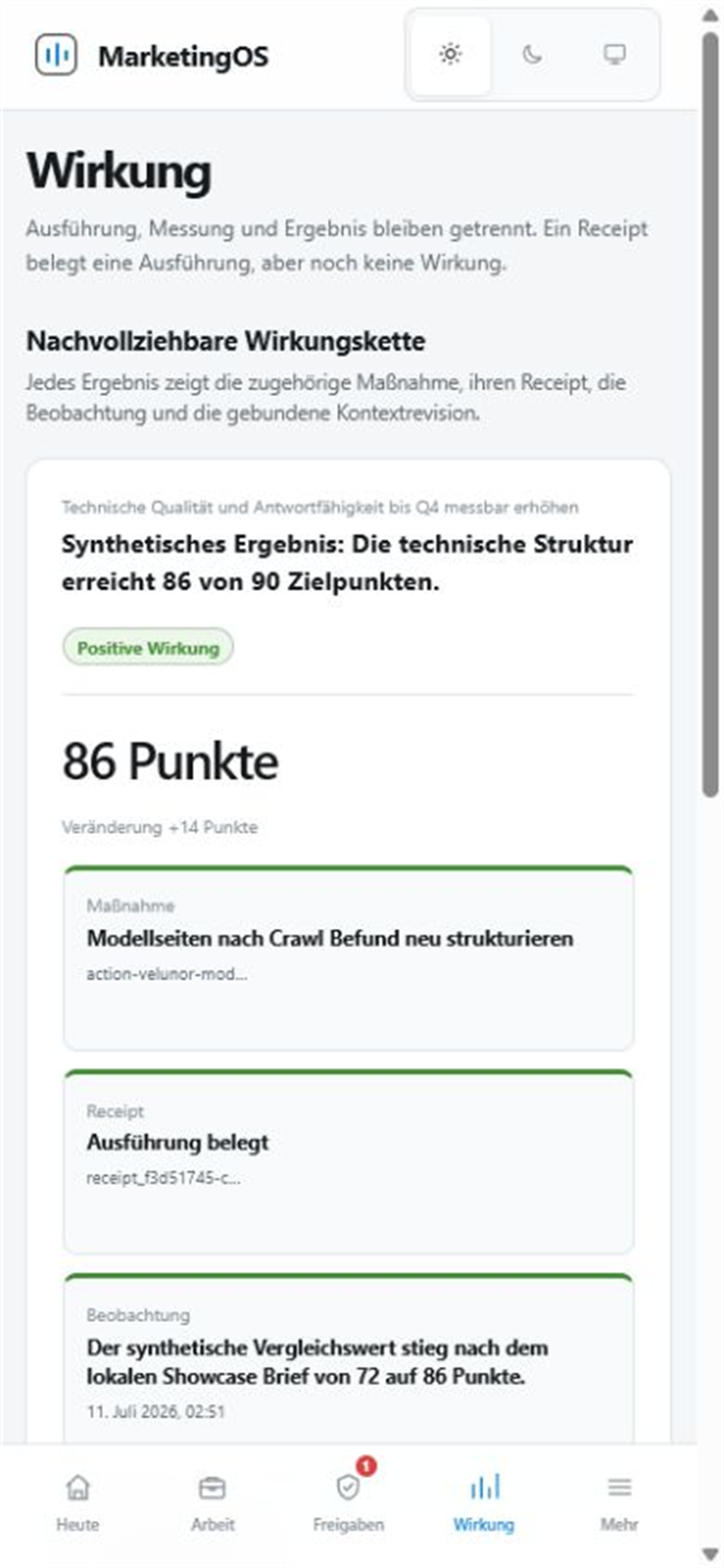
The receipt is only half the truth.

The synthetic chain connects an action, receipt, evidence, observation and outcome. Its values demonstrate the product logic. They do not come from a real website or customer project.
  • Action and receipt
  • Synthetic comparison
  • Onpage Health 86 of 90
  • Confidence 40 percent
  • externalWrites 0
MarketingOS outcome view for the synthetic Velunor Bikes showcase with complete provenanceMobile MarketingOS outcome view with a synthetic comparison and complete provenance

Control inside the workflow

Approval applies to a concrete action, not to an agent in general.

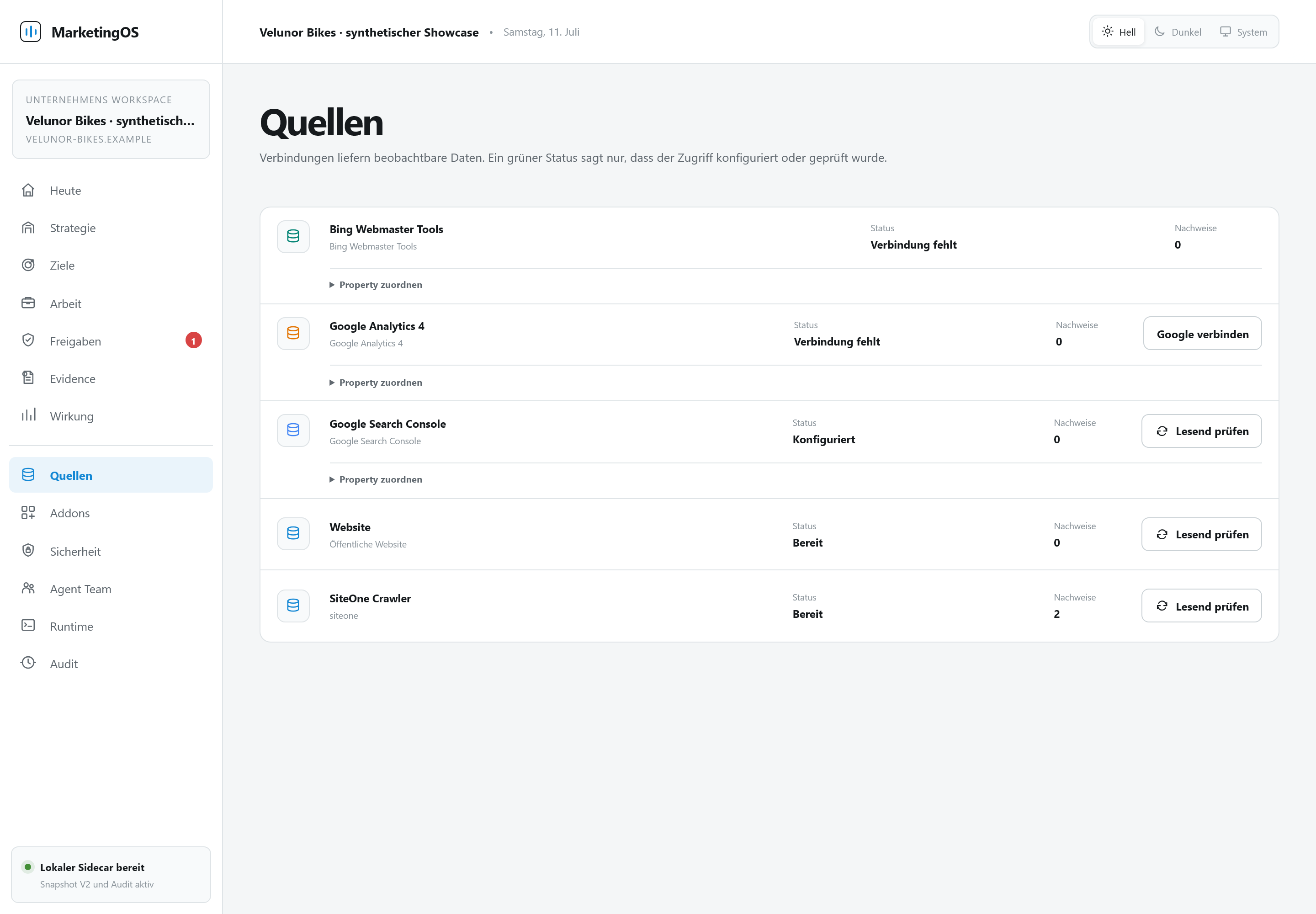
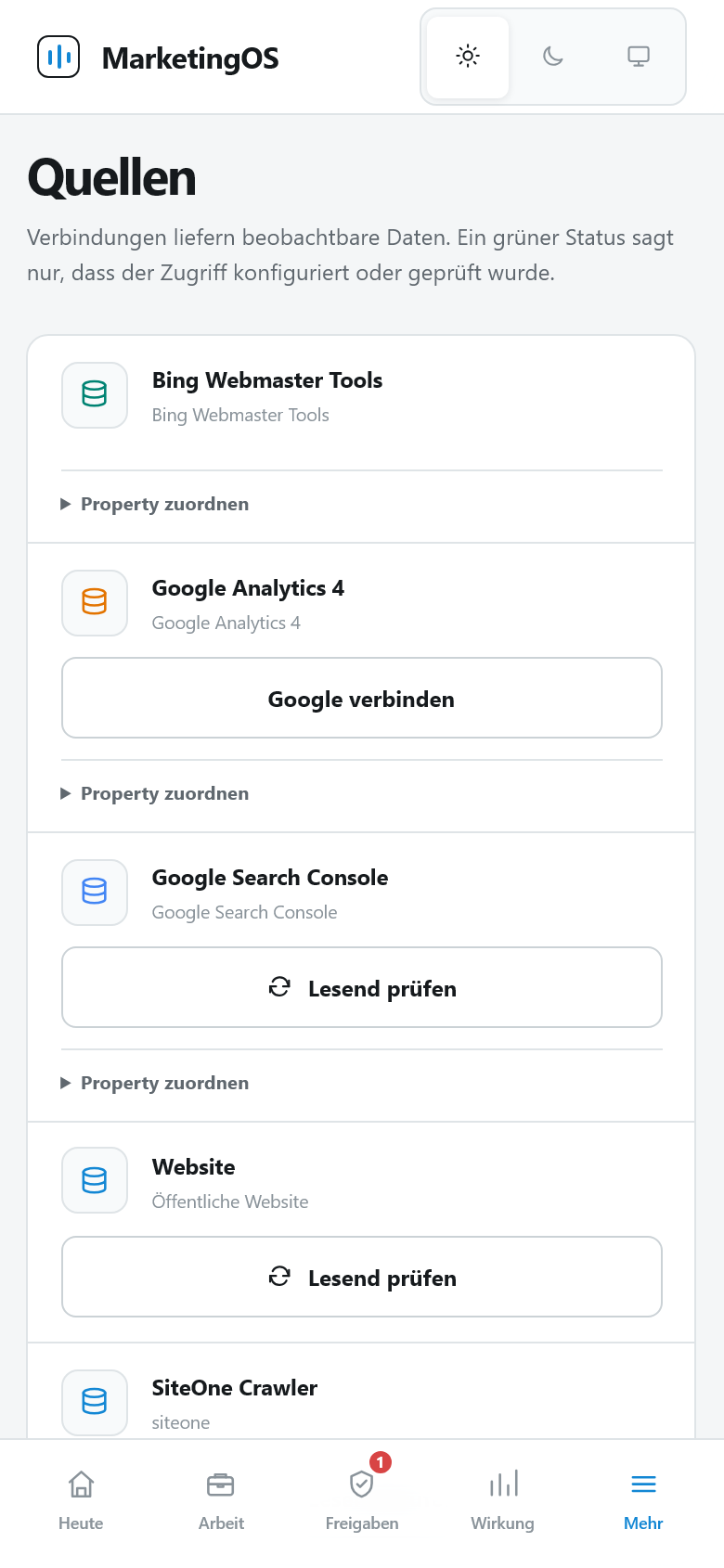
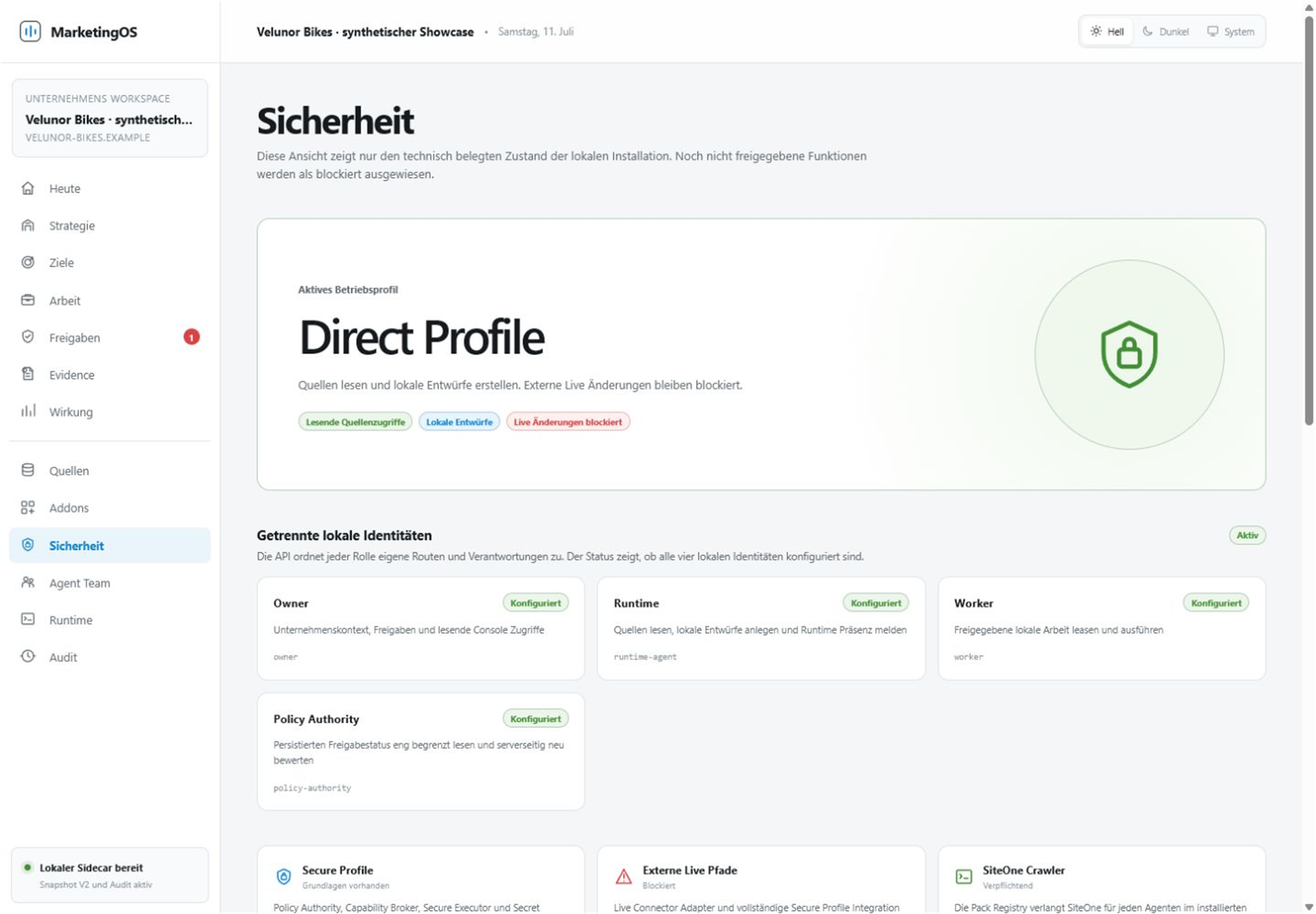
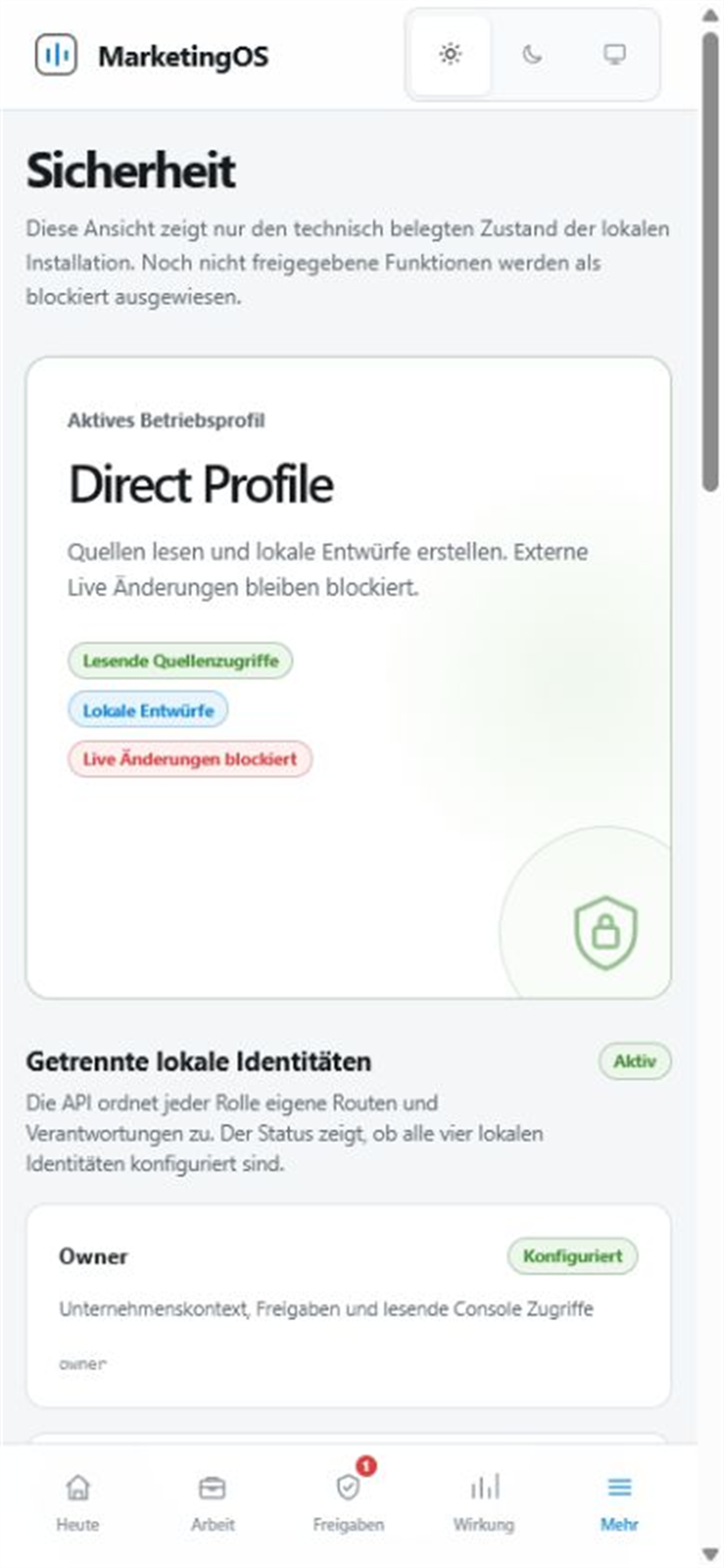
MarketingOS may read, organise and prepare local drafts on its own. As soon as a CMS, repository, ticket, Google account, Bing account, outreach channel or budget may change, that action needs its own scope and review path.

READ

Read independently

Inspect sources, record evidence and report missing access without changing an external system.

APPROVAL

Decide before the write

Target, content, risk, approval, backup, restore and verification are known before execution.

RECEIPT

Prove execution

Time, target system, result, external writes and the related decision remain connected.

A marketing agent becomes useful when you can still explain afterwards why it acted.

MarketingOS

The division of responsibility

OpenCLAW supplies the runtime. MarketingOS supplies the marketing operation.

Runtime

What does the work run on?

Models, compute, sessions, memory, tools, secrets, schedules and channels come from OpenCLAW or Hermes.

Context

What is the work for?

Company, brand, offer, audience, markets, goals, KPIs, tone and boundaries come from MarketingOS.

Team

Who owns each part?

An orchestrator and separated specialist roles share assignments, findings, handovers and QA.

Ledger

What can be proven?

Evidence, decisions, approvals, receipts and later observations create the traceable record.

OpenCLAW path

What we have already proven on a fresh instance.

Verified on 10 July 2026

  • The native installer registered twelve MarketingOS agents in separated workspaces
  • A real end-to-end turn started the marketingos orchestrator in OpenCLAW 2026.6.10
  • The orchestrator started marketingos-tech-seo in its own child session. The specialist read the current website, connected Action, Receipt and Evidence, and returned the analysis. All 37 checks passed with Context revision 2 and externalWrites 0
  • A separate technical outcome chain connected the website read, receipt, evidence, observation and outcome. HTTP 200 is proven, while the outcome deliberately remains inconclusive at 10 percent confidence
  • The runtime loaded the workspace and MarketingOS skill
  • Three read-only tool calls completed without failure and the receipt reported externalWrites 0
  • The optional Control Surface loaded the fully synthetic Velunor Bikes showcase through the authenticated Local Agent / Sidecar
  • SiteOne 2.5.1 was detected as the managed crawler
  • The installation manifest and E2E receipt remain available as reviewable artifacts

Still open

  • The first pack scope focuses on SEO and GEO operations
  • The OpenCLAW runtime report proves one point in time. A recurring signal from normal agent work is not configured yet
  • Hermes installs twelve directly callable skills and one team bundle. Current receipts cover lifecycle, a model turn, native leaf delegation and a read only source run with HTTP 200, Action, Receipt and Evidence. externalWrites remained 0. Hermes does not support persistent named specialist agents or custom child roles
  • A safe live write in a customer workflow has not been publicly proven
  • There is no reliable customer data yet for time saved, visibility, leads or revenue

Public proof ledger

A green agent turn is a beginning. The Proof Ledger also states what it does not prove.

Open the Proof Ledger

Before installation

The questions worth settling before the first real assignment.

01What exactly gets installed?
MarketingOS is an agent pack. OpenCLAW registers the marketingos orchestrator and eleven named specialist agents. Hermes installs one orchestrator skill, eleven named specialist skills and one team bundle. Every skill has its own slash command and package pointer. Models, sessions and compute remain in your existing runtime.
02Does MarketingOS need its own AI model?
No. MarketingOS requires neither a particular provider nor a particular model. The existing agent runtime supplies model access, compute, sessions, memory, tools, secrets, schedules and channels.
03Has the OpenCLAW path actually been tested?
Yes. Twelve agents were installed. In a real source run, the Tech SEO specialist read the live website in its own child session and connected WorkspaceContext revision 2 with Action, Receipt, Evidence and synthesis. All 37 checks passed with externalWrites 0.
04How complete is Hermes support?
Three current receipts cover the Hermes path: 35 lifecycle checks, 16 checks for a model turn and leaf delegation, and 35 checks for a read only source run with HTTP 200, Action, Receipt, Evidence and externalWrites 0. delegate_task binds the exact specialist contract to a native leaf session. Hermes creates no persistent named specialist agents or custom child roles, so runtime parity remains partial.
05May MarketingOS change my website on its own?
Read only work is the default. A change to CMS, Git, tickets, Google, Bing, outreach or budgets needs a concrete scope, the appropriate approval and the intended backup, restore and verification path.
06When is an outcome actually proven?
A receipt proves execution, not impact. Impact is claimed only when the baseline, executed change, measurement window and later data from the appropriate source fit together.

Already running OpenCLAW? Start with a real marketing assignment.

The useful next step is one domain, one offer, one goal and one accountable person. That is enough to define the first bounded team assignment.

Open the OpenCLAW setup